
Your company exists. It has a name in the commercial register, a UID number and maybe a logo.
What it often doesn't have yet is a working account.
So invoices wait. Supplier payments wait. Your first hire waits.
The good news: most of the delay is avoidable. It usually comes from back-and-forth: one missing document, one unclear answer, another week gone.
This guide shows you how to prepare once, answer everything up front, and go live in days.
Why company accounts take so long
Any regulated provider that opens an account for a company has to know who it's dealing with. In Switzerland that's driven by anti-money-laundering rules (the Anti-Money Laundering Act, AMLA/GwG). In practice, it means "Know Your Business" (KYB) checks.
KYB boils down to four questions:
- Is the company real, and is it what it says it is?
- Who controls it and who ultimately owns it?
- What does it do?
- What money will flow through the account, from where and to where?
Every delay you've heard about is one of those questions being answered slowly, one email at a time.
Step 0: Know what kind of account you need
There are two very different moments in a company's life.
Before incorporation: paying in the share capital
First, the minimums. A GmbH needs at least CHF 20,000 of share capital, fully paid in (OR Art. 773, 777c). An AG needs at least CHF 100,000, with at least 20% of each share's nominal value and at least CHF 50,000 paid in (OR Art. 621, 632).
Since 2023, the capital doesn't even have to be in francs. It can be denominated in USD, EUR, GBP or JPY, as long as that currency is essential to your business (OR Art. 621 para. 2).
Cash contributions go into a capital deposit account (Kapitaleinzahlungskonto) at a bank, before the company is registered. That's a bank product, so you'll need a bank for it.
The awesome exception: pay in your capital with crypto
Here's what many founders don't know: if you already hold crypto, you can use it to pay in your share capital.
Legally, crypto isn't a cash contribution. It's a contribution in kind (Sacheinlage, OR Art. 634, which also applies to GmbHs through OR Art. 777c para. 2). That route works across Switzerland.
The canton of Zug is the best-known example. Its commercial register entered Switzerland's first company formation with a Bitcoin contribution on 25 September 2017. In Zug, BTC and ETH are accepted as standard. For other tokens, clear it with the register in advance. Other cantons have their own practice, so ask yours early.
What you need:
- A written contribution agreement (Sacheinlagevertrag) describing exactly what is contributed (for example "2.5 ETH", not just "crypto").
- A founders' report (Gründungsbericht, OR Art. 635) explaining the contribution and how it was valued.
- A confirmation from a licensed auditor (OR Art. 635a) that the report is complete and correct.
- The contribution stated in the articles of association (OR Art. 634 para. 4).
Plan a buffer. The CHF value of the crypto is fixed at notarisation, and it has to cover the capital. Prices move, so contribute more than the bare minimum. Hypothetical example: for a GmbH with CHF 20,000 capital, the founders contribute ETH worth around CHF 25,000 on the day they plan the notary appointment, so a price dip doesn't derail the founding.
Where Firma comes in: Firma can handle the digital-asset contribution, so your crypto has a proper home from day one and sits next to the CHF, EUR and USD accounts the company will use afterwards.
After incorporation: the operating account
Once the company is in the commercial register, you need an account to run the business: getting paid, paying suppliers, running payroll, handling currencies. This guide is about that account.
Firma is built for this moment (and, if you pay in your capital with crypto, the one before it). Firma is a regulated fintech, not a bank. It opens accounts for registered companies (AG, GmbH, LLC, partnerships and similar entities), not for sole proprietorships.
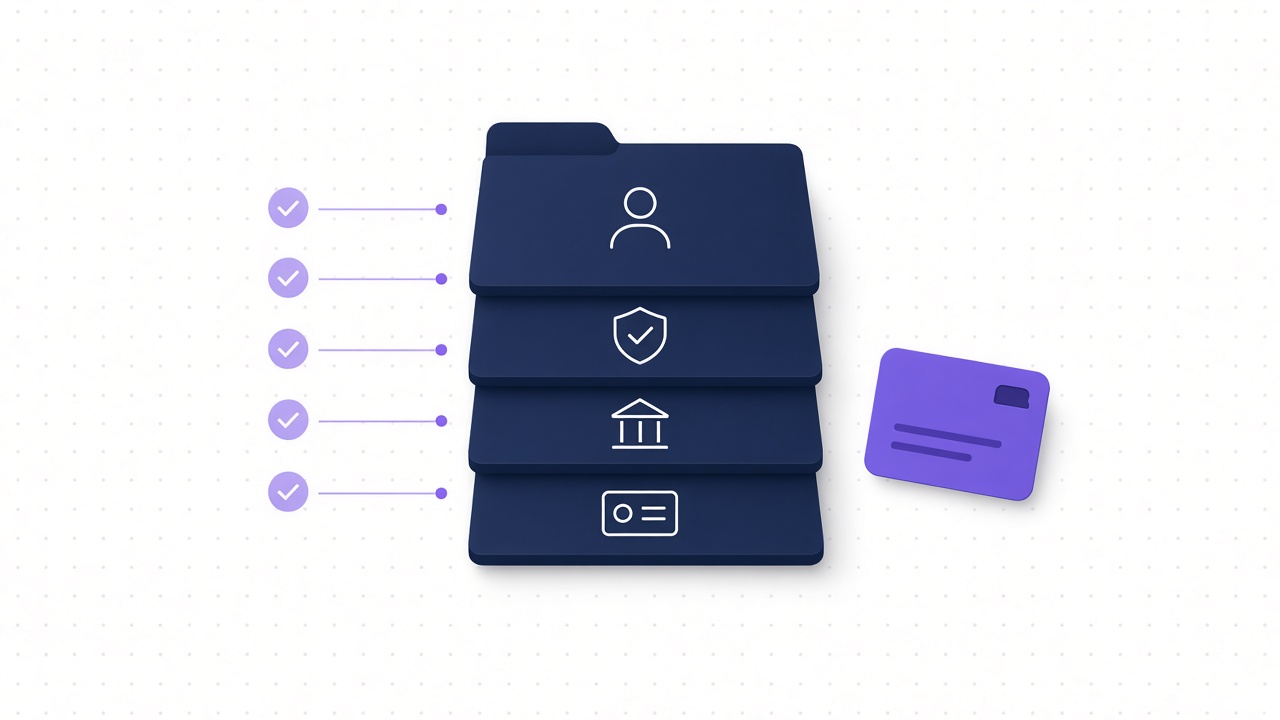
The 4-folder method
Make four folders before you apply anywhere: one per KYB question. Fill them once and reuse them for every provider you ever talk to.
Folder 1: The company
- A recent commercial register extract. You can look up your entry on Zefix, the federal company index, but providers usually want an official extract. Ask how recent it needs to be.
- Articles of association (Statuten), as currently registered.
- Your UID number and registered address.
- If the shareholder is another company, the same documents for that company too.
Tip: the name and address on your application must match the register exactly. "Muster GmbH" vs "Muster AG" or an old address is a classic reason for a "please clarify" email.
Folder 2: The people
- Valid ID or passport for everyone with signing authority.
- A clear list of beneficial owners: the natural persons who ultimately own or control the company (directly or through other entities).
- An ownership chart if there's more than one layer. One page, boxes and percentages. It saves several emails.
Folder 3: The business
Write three to five plain sentences:
- What you sell.
- Who your customers are.
- Which countries you operate in.
- Your website, if you have one.
Write for a compliance analyst, not a customer.
Folder 4: The money
This is the folder founders skip, and it's the one that causes the most follow-up questions.
- Currencies in: for example, CHF from Swiss clients and EUR from German clients.
- Currencies out: for example, CHF salaries and EUR to a supplier in Austria.
- Rough monthly volumes: an honest estimate is fine.
- Counterparty countries: where money comes from and goes to.
- Anything unusual: stablecoins, marketplace payouts, client money. Say it up front and explain it.
Hypothetical example: "We're a 4-person software company. We expect around CHF 40,000 a month in, mostly CHF from Swiss clients and some EUR from Germany. Out: salaries in CHF, cloud tools in USD, one EUR contractor in Portugal."
That paragraph answers half the follow-up questions.
The fast-track sequence
With the four folders ready, the process becomes boring, and boring is fast.
- Pick a provider that fits your flows. If you invoice in EUR and pay in USD, check those currencies and rails exist before you apply. (More on that in How to Pay EU Suppliers from a Swiss GmbH (SEPA vs SWIFT).)
- Submit everything in one go. No "I'll send the ownership chart later".
- Answer follow-ups the same day. Every day you wait is a day added to the timeline.
- Have every signatory available. If a co-founder is travelling, plan their ID check around it.
- Go live, then configure. Set up users, approvals and integrations after the account opens, not during.
At Firma, the sequence is: verify, then subscribe, then start. Verification takes about two days once we have the company. If we can't verify the company, there's nothing to pay.
5 things that slow you down (and the fix)
- Register mismatch. Name, address or signatories differ from the extract. Fix: copy from the extract word for word.
- Hidden ownership layers. A holding company "we'll explain later". Fix: the one-page ownership chart.
- Vague business description. "Consulting and services". Fix: say what you consult on, for whom.
- Unexplained flows. Crypto, client money or high volumes with no context. Fix: a short paragraph in Folder 4.
- Wrong entity type. Sole proprietorships can't open a Firma account. Fix: check eligibility before you start.
After you're live: the first 48 hours
Use the first two days to set things up properly:
- Open the currency accounts you'll actually use. Not "just CHF" if half your revenue is in euros. See The FX Fee Your Bank Never Shows You.
- Send new payment details to clients, in writing, from a trusted channel.
- Agree how your Treuhänder gets the data: monthly statements for now. Firma's accounting integrations are coming soon.
- Set up how bills get approved before the first one arrives. See Forward a Bill, Click Approve: Accounts Payable on Autopilot.
- Agree who can pay what. Even in a two-person company.
Still in your first year? Read 7 Money Mistakes Swiss Founders Make in Year One.
Bottom line
Speed isn't luck. It's preparation.
Fill four folders, submit once, answer the same day.
FAQ
How long does it take to open a business account in Switzerland?
It depends on the provider and how complete your application is. Most delays come from missing documents and follow-up questions. At Firma, verification takes about two days once the company details are in.
Can a sole proprietorship (Einzelunternehmen) open a Firma account?
No. Firma opens accounts in a company's name: AG, GmbH, LLC, partnerships, public corporations and similar entities. Sole proprietorships aren't eligible.
Can I use Firma to pay in the share capital of a new GmbH or AG?
For cash contributions, no. Cash goes into a capital deposit account at a bank, and Firma isn't a bank. For crypto contributions (a contribution in kind under OR Art. 634), yes: Firma can handle the digital-asset contribution. You'll also need a contribution agreement, a founders' report, an auditor's confirmation and a clause in the articles.
Can I pay in share capital with Bitcoin or Ether?
Yes, as a contribution in kind. It's possible across Switzerland. In Zug, BTC and ETH are accepted as standard, and other tokens should be cleared with the register first. The CHF value is fixed at notarisation, so plan a buffer.
What documents do I need to open a company account?
Typically a commercial register extract, articles of association, IDs for signatories, beneficial-owner information, and a description of the business and expected flows. Providers can ask for more depending on your setup.
Do I pay anything if verification fails?
At Firma, no. You verify first, then subscribe. If we can't verify the company, there's nothing to pay.
Open your Firma account
Firma gives your company accounts in USD, EUR, CHF, GBP, CAD, MXN and BRL, plus payments by Swiss QR, SIC, SEPA, SWIFT, ACH, Fedwire, FedNow and stablecoins, all from one place. Verification takes about two days. If we can't verify your company, you pay nothing.
Keep reading: The QR-Bill, Explained for Busy Founders and How a Swiss Company Can Receive USDC (and What to Do Next).
This article is general information, not legal, tax, or investment advice. Talk to a qualified adviser about your situation.
Firma is a regulated financial technology company, not a bank. Banking services are provided through banking partners. Balances are digital stablecoin tokens, not bank deposits, and are not covered by esisuisse.
Sources: Swiss Code of Obligations (Art. 621, 632–635a, 773, 777c); Commercial Register Zug, factsheet on paying in capital with cryptocurrencies; Zefix; Firma FAQ.